Thursday, December 31, 2020

The Unblessed Ch. 3 and 4, Prologue

 So Collin (Why is he always referred to by his last name?) enters the cave which is notable for a few features. One: It's huge and man-made. Two: Phosphorescent crawly things. Three: Piles of dead people. Four: A demon.

The demon is described as "a mass of glowing bioluminescence so blindingly brilliant that he could not make out the true form of its body. The rays of multicolored light played on the walls of the cavern... towering at least fifteen feet..." So it's giant, amorphous, colorful and glowing. It sounds like something you'd see advertised for three installments of 9.99 on late night tv. Does late night tv still exist? If it does they're definitely selling this to somebody as a guaranteed way to help your children not be afraid of the dark or as a ward against home invasion or maybe as a holiday decoration. I don't know what holiday would require a dazzling rainbow demon on your front lawn but if someone could find a way to sell kitsch they'd create one.

There are also brain-washed "Devil's men" lined up. In the cave, not on late night tv. Also on late night tv. But these ones are all wearing "jungle clothing" rather than "European clothing" so none of them belong to his group or the hunting party they were looking for. Oh, wait - there they are! The hunting party is all dead except for the tracker, Chaka, who is soon brought in for the demon to feast on. As Collin watches from the shadows Chaka is submitted to terrifying, hallucinatory images that float in front of him like a macabre light show. All the horrors of "Gargoyles, unicorns, and sea serpents." Eventually the demon gets tired of entertaining horrifying his victim and starts the drawn out process of feeding on him with tendrils that burn his head and eyes, leaving him dead.

Collin finds his friends, still caught in the grip of the demon's control, forced to watch the death of Chaka. When the "Devil's men" go for McPhearson he decides it's time to act and explodes their heads with his gun. Of course he's overpowered almost immediately and McPhearson is taken away but he manages to shove the medallion down Smith's shirt which helps Smith fight off the demon's influence. The two of them start walloping and shooting their way free. In the meantime, McPhearson succumbs to his horrible fate and Collin shoots him to put him out of his misery. (What did I say about McPhearson? He was a happy family man; do I know my clichés or what?)

Once outside the cavern, Collin and Smith make for a distant ranger station where they get to collapse in safety. Five days later they head back with a camera and explosives intending to document I'm not entirely certain what. The cave entrance? The people who from a distance just look like people? Were they actually going to sneak in and take pictures of the devil? After their well-thought out plan, I'm sure, they were going to blow everything up. Before they can, everything collapses by itself and they see "a brightly, glowing object, a large C-47 cargo plane... Clearly it had taken off from a hidden airstrip in the valley beyond the next hill." I didn't know there was a valley, I thought we were in "deep jungle" or "rain forest" but apparently the demon owns enough land to build an airfield.

"It's gotten away from us," Collin murmured in disbelief. "God in heaven. Now it could be anywhere. Anywhere on this earth. How are we ever going to find it?" p.110

I'm not sure why he came to the conclusion that the demon made it's escape on a C-47 instead of say, someone else getting wind of this apparently open secret of where this thing lived and coming to destroy it as well but nevermind. The demon absconded in a C-47. Aren't those kind of big? It's meant to cart troops around. Maybe he took all the brain-washed men Collin and Smith didn't kill with him.

Anyway, they resolve to go talk to Hasha about where it might be because that poor, sad bastard still has a minor mental connection to it.

The prologue to the next chapter opens like this: "A feeling of brooding menace pervaded the basement room that was roughly square, and perhaps thirty feet on a side." p.112

The set-up within that room has your typical satanic accoutrements: pentagram, candles (blood red), altar, chalice (gold), book (gilt-bound, though he probably meant -edged), mirror, dagger (silver) and a dead animal (small, species unknown). There's also Maximillian Grey (dark, latin good looks) performing a ritual. He chants words, tosses powder around and drinks blood, the usual, and soon a figure appears in the mirror whereupon Grey offers the "Master of the Outer Darkness" his body. To wear. "After an absence of ages, the Guardian had returned to Earth." p.115

I'm digging this book. It's so action-packed and quite frankly, ridiculous. I love it.

Sunday, December 27, 2020

The Unblessed by Paul Richards Ch. 1-2

 I've been on an old horror books kick recently, started by reading Henderson's Paperbacks from Hell.

There's something nice reading fiction totally removed from the current world. No internet, cell phones, hacking, pandemic, nationalist movements, etc. Diseases tend to be very non-specific, technology is often either benign or a force for good. People still have to go to stores to buy things and go to the library to research matters. It feels so foreign. You also get more unconscious misogyny and racism but you can pretend that belongs in the past.

Currently I'm reading "The Unblessed" by Paul Richards published by Zebra Books in 1982.

The Unblessed Cover showing a panther's gaping mouth.
The author's foreword assures us that he researched a lot for this book, even the "various psychic phenomena".

The prologue takes us to Sudan in January, 1970 where Dan Hunt arrives at an archeological dig to meet Dr. Mason Raymond and John Garfield who have discovered something amazing, a sacrificial altar from 3500 years ago and an inscription corresponding to legends about a demon named Anthrada, a priest named Cymonatha and the hero who took him down, Niyikang. (According to the foreword this guy is "an actual person whose exploits have been handed down from generation to generation through the oral tradition".)

The trio makes their way into this recently uncovered site while info-dumping about the legend until they get to a giant cavern whereupon they view "the hideous contents of the deep, hollow depression" "aghast". At this point Garfield is apparently possessed and makes at the other two, presumably with murder in mind, but unfortunately mister clumsy trips on a rock and goes whoopsie down into the pit. Where, I guess, he dies. The other two resolve to seal off the site. "What if there were more such creatures?" What creatures, you might ask? I don't know. Whatever possessed Garfield. What did they see in the pit? Beats me. Bodies?

We forward 11 days to Zaire and a small village containing one Christopher Arthur Collin, a journalist researching the illegal ivory trade, there with his partner Terry McPhearson. Collin has "fiery, animated eyes" and "lean weathered features". "The Levi's-clad American" is worried because the "Sedgewick hunting party" is overdue back and he worries for his fellow countrymen. Lord Sedgewick though so I don't know if an Englishman is employing Americans or Richards just wanted to sound fancy or what.

Collin decides to take it upon himself to find them and approaches a "native ranger" he knows "whose tribal name was Lianga" but calls himself Smith. He finds Smith in his small quarters reading "Plutarch's Lives" of course and Smith resolves to take Collin and McPhearson into what is alternately called the deep jungle and the rain forest but only if they stop at a village along the way to find out why going into Anansi, the Spider God's land is verboten.

They reach a village where the chief, Luba, takes them to an old man named Hasha whose "eyes themselves had somehow been burnt out completely, as though red-hot pokers had been thrust ruthlessly into his sockets and held there." Through Smith, Hasha tells a (long, rambling, ungrammatical) story of wandering into the wrong land while hunting and being taken captive by mind-controlled men. He was brought to a cave where the demon spoke into his mind to feed off his brain and had his eyes burned out. Unfortunately for the demon, Hasha has a benign brain tumor and his thoughts are poisoned? Or something? So he was let go and found by another group later on. He's kept by the village as a warning.

Smith is given a medallion to keep him safe and they go on their way. We learn McPhearson has a wife and sons so I'm calling his future death. While on watch McPhearson is invaded by the demon, cuts the medallion off Smith and wanders with Smith off into the trees leaving Collin to wake up alone and confused. Yolana the Priestess said she believed that her entire purpose in life was to be there to give her Great-great grandma's protective amulet to Smith but boy did it seem easily bypassed.

Collin goes looking for them but when he finds them of course they're evil or whatever. They try to bring him into the fold but something about him wards off possession. They try to shoot him and he gets away. He can't stand the thought of leaving them behind so he follows their tracks and comes across a cave entrance being guarded by two men. He uses the Hitman approach to lure them away - throwing things far from where you don't want them so the NPCs will alert and investigate the very obvious distraction. As he slips inside he hopes he can save his friends.

It is a wordy book; not only in length of description but it's the sort where "cogitate" is used when "thought" would do. Also, we keep getting reminded that Collin is "white" and Smith is "black" which is awkward and weird. But despite that it's an entertaining read and I'm curious as to where we're going to end up.

Wednesday, December 11, 2019

Finds - The Mystery of the Ivory Charm

I have bought things other than language books. There are a number of interesting books that end up at the library book sale. One of them was this copy of the 13th book from the Nancy Drew series, The Mystery of the Ivory Charm by Carolyn Keene, first published in 1936.

I bought it for...a dollar? I think? The librarian I paid down at the circulation desk was always really weird toward me, acting like I was suspicious whenever I bought something and I remember she actually went and checked with another librarian to make sure that really was the price. There are the shelves where you pay by type of book and then another section where the books have price stickers because they are more valuable. I think she thought I'd taken the sticker off to get it at the normal hardback fiction price. I am so glad she no longer works there. I don't know what I did to make her think I was some sort of cheat.
Anyway. The initials of whoever owned it were S.A.

Blue cloth cover for The Mystery of the Ivory Charm. Black silhouette Nancy Drew with magnifying glass. 1936. 1950s.

Title page. Nancy Drew Mystery Stories. New York, Grosset & Dunlap, Publishers

Well, not actually by Carolyn Keene. These adolescent book series were ghostwritten by a number of different people, apparently, and this one was penned by Mildred Wirt Benson. It's 216 pages and 19cm x 13cm. There's a picture endpaper and one picture at the start of the book.

Ivory Charm endpaper illustration. Nancy Drew hiding behind tree watching man digging a hole beside a shed.

Frontispiece for The Mystery of the Ivory Charm. Nancy Drew stopping a man in a turban from striking a boy with a whip. Elephant and circus carriage in background. "Don't dare to strike that boy again!", Nancy commanded.

The illustrations were done by Russell H. Tandy and the original edition had more and in color from what I've found. This particular copy must have been printed in about 1954 or so because there is a list of other books in the series and one for the Dana Girls Mystery Stories and both of the last books listed were published in 1953. The dust jacket did not come with the book.

It was sold at The Book Shop in Fitchburg, MA.

Sticker with text. The Book Shop. Fitchburg, Mass.

It appears to have been at 536 Main St. and opened in 1952 by a man named Alexander Krysil and run until his death in 2014. Here's a link to a picture of their window display in the 1958 Billboard.

I have never read a Nancy Drew book in my life.

Sunday, November 24, 2019

Introductory Punjabi - Inside

I honestly love the example sentences in this book. They feel like they've been taken out of random conversations that we don't have the context for.  You could make up mini scenarios for most of these.

Introductory Punjabi. Bahri. Walia.
"I too slapped him."


Introductory Punjabi. Bahri. Walia.
"But she seemed quite young."

There are quite a number of sentences about thieves and beatings.
Introductory Punjabi. Bahri. Walia.

Introductory Punjabi. Bahri. Walia.
"If Bihari Lal dares open his mouth, I will fix him well."
I feel like every language book should include this sentence with [insert name here]. It should be an essential phrase.

Introductory Punjabi. Bahri. Walia.
And, of course, at the end you have your vocabulary.
Introductory Punjabi. Bahri. Walia.

And a few more sentences I never thought I'd see in a phrase book but am now saddened by the fact that I haven't. These are phrases of living rather than visiting.

"Not to talk of running, he can't even get up (from his seat)."
"Paramjit! what a hell of a girl she is?"
"A girl! she is a virtual bat."
"Do not step on the engine." "Don't keep your arms outside the window." "Do not jump from a running train."
2 different ways to say "Plucking flowers is prohibited."
"May you be a widow!" "What can such children do for the country?"
"Some body told me that you have lost your clothes."
"Well, when we are turned out of this house, you may come."
"Your performance has been much better than what we expected of you."
"Rather than act in such a manner, you should have thrown yourself in the river."
"My father, who is over forty now, still plays hockey."
"As soon as you entered his room you could appreciate his aesthetic sense."
"Stop here for octroi." "Beware of quack doctors." "Get yourself vaccinated." "He was sentenced to two years rigorous imprisonment."
"Her husband drinks (wine) too much." "A boy was run over by a motor car." "He is just a yes-man."
"The sight of the yellow fields of Saron is very delightful during the spring season."
"Death is inevitable."

Saturday, November 23, 2019

Introductory Punjabi

The Language learning book with my most favorite example phrases is Introductory Punjabi, put out by Punjabi University Patiala. Looks like the school is still around, too.

Introductory Punjabi. Punjabi University Patiala. Bahri & Walia. Cover.

I'm going to assume the authors listed were instructors there. Bahri appears to have written a few other texts on the language as well as one on Hindi. https://www.amazon.com/s?k=Introductory+Punjabi+bahri&i=stripbooks&ref=nb_sb_noss

Introductory Punjabi. Punjabi University Patiala. Bahri. Walia. Title page.

We even get the price the students had to pay for their textbook.

Introductory Punjabi. April 1968. Price: Rs, 2.00. Printing information.

WorldCat lists 3 different editions - this 1968 one, 1987 and 2003. 30 libraries have a copy including the Library of Congress. https://www.worldcat.org/title/introductory-punjabi/oclc/62665?referer=di&ht=edition

This book is not actually for English speakers despite being in English.

Introductory Punjabi. Bahri. Walia. 1968. Preface page.

So this text isn't truly complete as is. You need familiarity with Punjabi cultural items and a native speaker to listen to and practice with.

Introductory Punjabi. Bahri. Walia. Note on pronunciation and orthography.

The back cover of the book just has the price again. It's 114 pages and 22 by 14cm.

Next post will be the interior.

Saturday, October 19, 2019

Hindi in a Month - inside

So inside you find the normal parts of a language workbook: lists of vocabulary, exercises requiring you to translate short paragraphs, instruction on how the language is used. What's interesting is the choice of words for vocabulary and the example sentences used. An American or English book might not give you the translation for the castes or worry about whether you could say "Incarnation".

"Palpitating" is also not a word I would expect to learn in a beginner's course.


The vocab sections are broken up into examples of words starting with a certain written character and sections with a theme. Here's one on hygiene and self-care.


Here's a section on disease. Note: Fatness can be cured in 40 days.


There are also several pages with common sayings, many of which are familiar to me. Some of which are not.


Then grammar. Don't do it?

We have example sentences.


And here are sentences from the section on cloth.


A bit of instruction on fruit and vegetables.


Mangoes are mentioned quite a bit in the book. Mangoes are mentioned quite a bit in the book on Punjabi I also own. This is why I like seeing language books published elsewhere - they have a different flavor from what I am used to.

Monday, October 14, 2019

Hindi in a Month

I like old, bilingual dictionaries and learn to speak another language books. I especially like old bilingual books when they were written and sold in another country. You get an entirely different set of example sentences and textual flavor than you do when they're from your own country, written with someone of your background in mind. So when I see them at my local library book sale I snap them up. I've found quite a few gems and I've wanted to share them.
Hindi in a month. J. S. Bright. Cover.

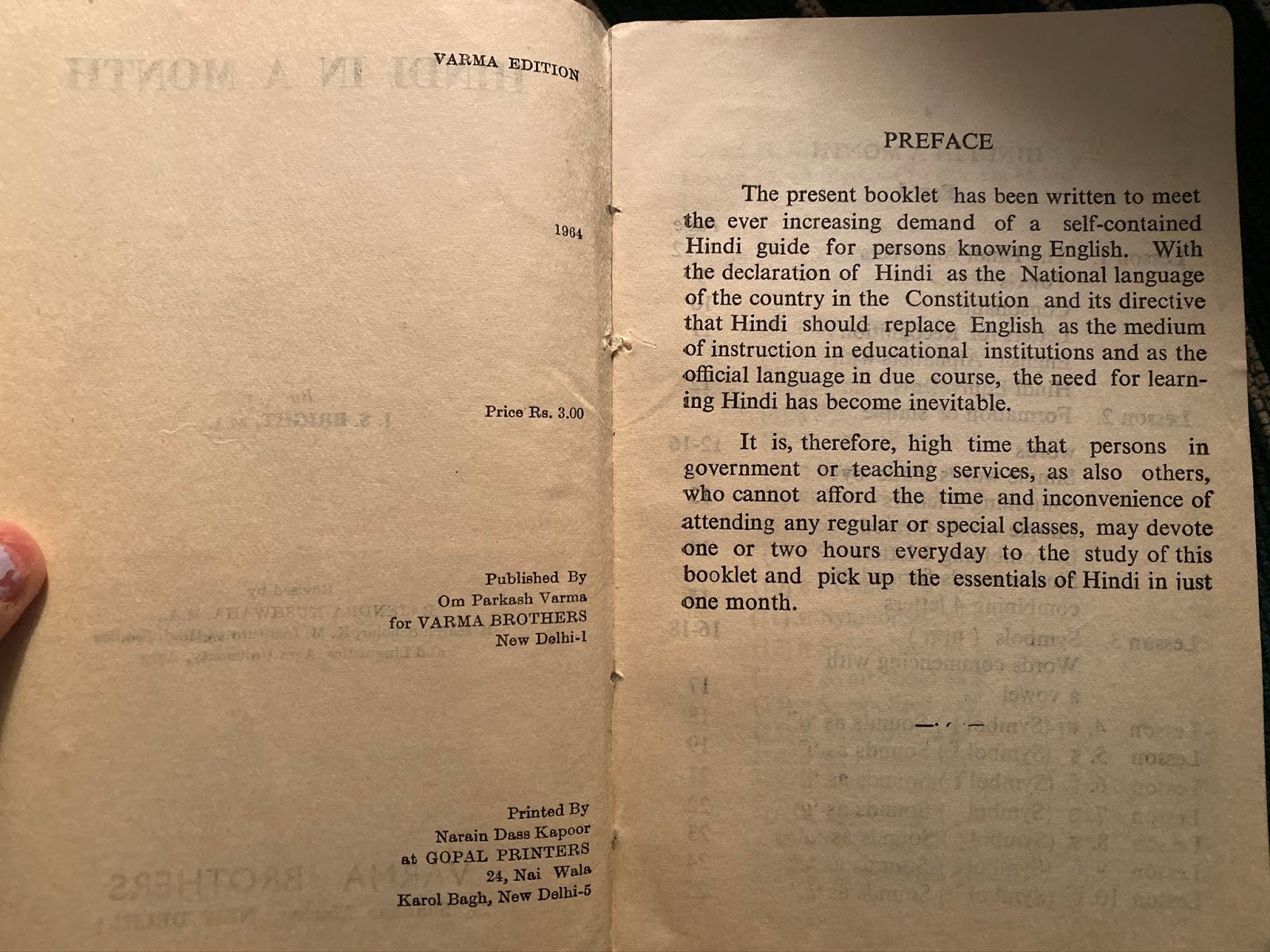
I have been unable to find a copy for sale or referenced online outside of Worldcat - there are 7 copies of what appears to be 3 different editions, none of which quite match mine. This one here was published for the Varma Brothers in 1964. It is 205 numbered pages, 18 cm.
Hindi in a month. Bright. Preface.
The other cataloged books were published 1962, 1966 and 1951. The last was published by National Book Stall. It appears to have gone through several editions. The author is only listed as J.S. Bright but his entry on library pages gives the name Jagat Singh Bright.
Hindi in a month. Bright. Varma Brothers. Title page.
Looking at other works he is connected to it appears he made quite a career writing and editing books about Indian history, language and important figures. A cursory search turns up nothing on Rajendra Kushwaha. This copy was sold at Minerva Bookshop.
Minerva Bookshop Simla Bombay stamp.
Are Simla and Bombay completely separate locations? There's a Shimla north of New Dehli but I'm not finding any on the map near Mumbai. Did Minerva Bookshop have two stores? Is the Minvera Book House in Shimla the inheritor of the Minerva name? Not amazing detective work but I'm being lazy. Here's the back cover.
Hindi in a month. Bright. Back cover.
And here's a list of their other publications:
Varma Brothers other publications pages.
I'm especially interested in "Friends: How to win and retain them", "Ideal jokes", "Timber calculator" (I have no idea - do you calculate timber? probably.) and my favorite - "How to increase your height".

More on the contents of the book in the next post.